The IHB main line extends 39.4 miles from Ivanhoe on the west side of
Gary, Indiana, to Franklin Park, Illinois, near O'Hare Airport. It runs west
from Ivanhoe through Gibson (Hammond, Indiana) to Blue Island, Illinois. There,
it heads northwest and then north through Chicago's western suburbs. It is
mostly double track. From Blue Island to a point near McCook, Illinois, the track
and infrastructure are owned and maintained by CSX subsidiary, Baltimore &
Ohio Chicago Terminal. However, IHB dispatches the entire route. In addition,
the 7.1 miles of main line from Ivanhoe to Calumet Park, Illinois, is operated
on a long-term lease agreement. From Calumet Park to Blue Island, and from
McCook to Franklin Park, the track is owned outright by the Harbor.
 IHB has another major route known as the Kankakee Line. It extends south from the lakefront at Indiana Harbor (East
Chicago, Indiana) to a point near the crossing of the now-abandoned Erie-Lackawanna railroad, a
distance of about seven miles. The main and Kankakee lines cross in Hammond, Indiana at Gibson
Junction, where the IHB shops are located. The IHB's headquarters building is
also at Gibson.
IHB has another major route known as the Kankakee Line. It extends south from the lakefront at Indiana Harbor (East
Chicago, Indiana) to a point near the crossing of the now-abandoned Erie-Lackawanna railroad, a
distance of about seven miles. The main and Kankakee lines cross in Hammond, Indiana at Gibson
Junction, where the IHB shops are located. The IHB's headquarters building is
also at Gibson.
Blue Island Yard, located near Riverdale, Illinois, is the heart
and soul of the IHB. It is one of the largest and busiest yards in the Chicago
area with 44 classification tracks and a hump for eastbound traffic. It is a
major destination and origination point for most of the Class I railroads.
There are several other major yards as well. Gibson Yard in Hammond
handles auto rack cars exclusively. IHB's shops, headquarters and servicing
facilities are located at the east end of the yard. Michigan Avenue Yard in East Chicago
marshals traffic for the steel industries along Lake Michigan, as does Lakefront
Yard in the Indiana Harbor area. Lakefront also serves as an interchange point
with other area railroads. Argo Yard serves the huge
Corn Products plant near McCook, Illinois. Smaller yards like Burnham and
Norpaul serve local industries and build transfer movements.
Approximately 40%
of the Harbor's revenue is derived from transfer traffic between other railroads
together with switching and trackage
rights fees. The remaining 60% comes from online industries, and about half of
that is related to the steel industry. A large chunk of the rest is derived from
grain processing plants throughout the Chicago area.
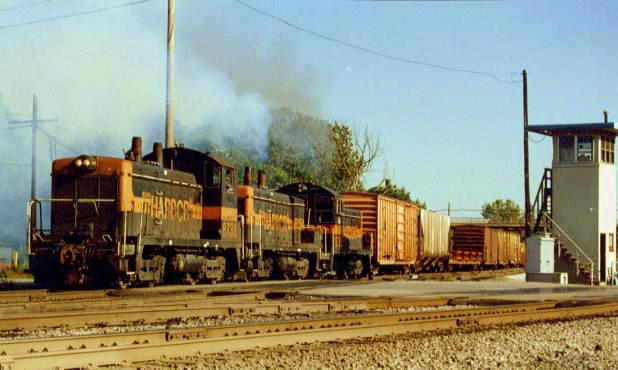
This website was originally developed by our friend "Lightnin" and
many of his fine photographs have been retained. He was a great help in expanding
the Archive. Sadly, he passed away in March, 2016, and this
site is now dedicated to his memory. Thanks go also to Spence Ziegler, whose collaboration
in developing the website was essential. It is hoped that you will enjoy looking through these pages and encourage everyone who has
IHB-related photos and data to submit them for posting. More photos will be added in the future and other pages will be
updated frequently. Check back with us often.
The four six-axle gensets (2160-63) have been retired. They will be scrapped later this year.
Four locomotives have now been equipped with PTC (4011, 4013, 1506, 1508) and more conversions are being planned.
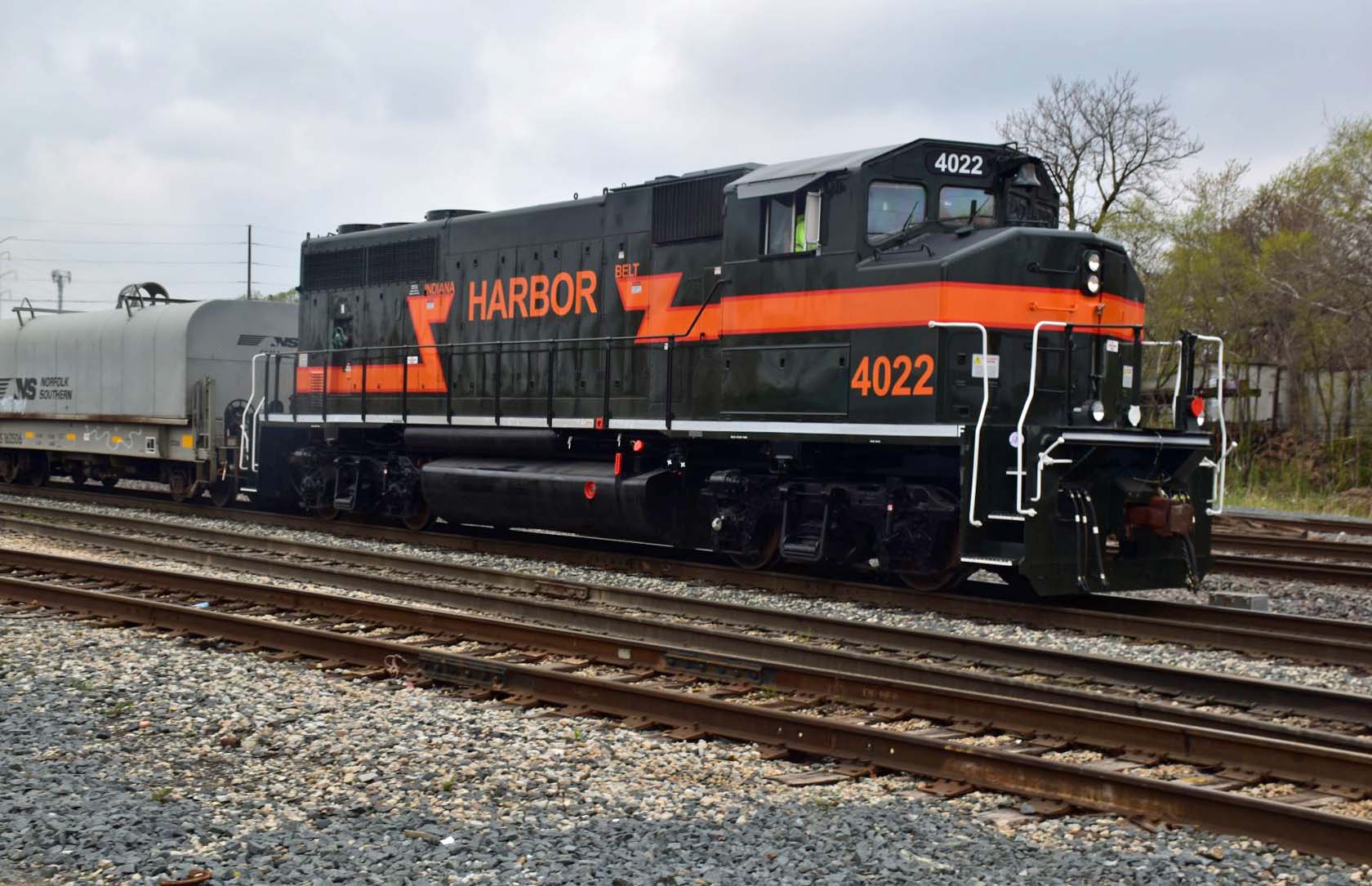
The recently acquired GP40-2LW wide cab units (4020-4022) have been paired with three of the four-axle gensets that were converted to slugs. For details,
see the roster pages. A photo of one of the widecabs is at the top of this page.
The SW1500 locomotives are being rebuilt and repainted in a "new" paint scheme very similar
to the original Lightning Stripe livery of the 1950s.
For a photo go to the Roster and Livery Data page, click on the "Diesel Locomotive Color Schemes" link, and scroll down to the bottom.
Four SW1500s (1504,1506,1508, 1514) have been converted to dual fuel compressed natural gas units. They are now designated RP15BDF.
In May, 2021, IHB puchased a rebuilt GP38-2 upgraded to Dash-3 standards, numbered 3800, painted in a unique "Salute Our Troops" scheme.
For a photograph, go to the Photos page. Click on the thumbnail image in the top row.
--Bill Gustason.
NOTICE: The texts and photographs on this website are free for the taking
as long as it is for your own personal use. If however any material from this
site is downloaded for public use, whether in print or verbally or on the
internet, the source of the information should be publicly acknowledged. No
material on this site may be used on a for-profit basis without the
authors' written consent. This prohibition applies to everyone, including
publishers and authors of rail-related books and DVDs.